
How to Hunt in BC
Obtaining your FWID and Hunting License
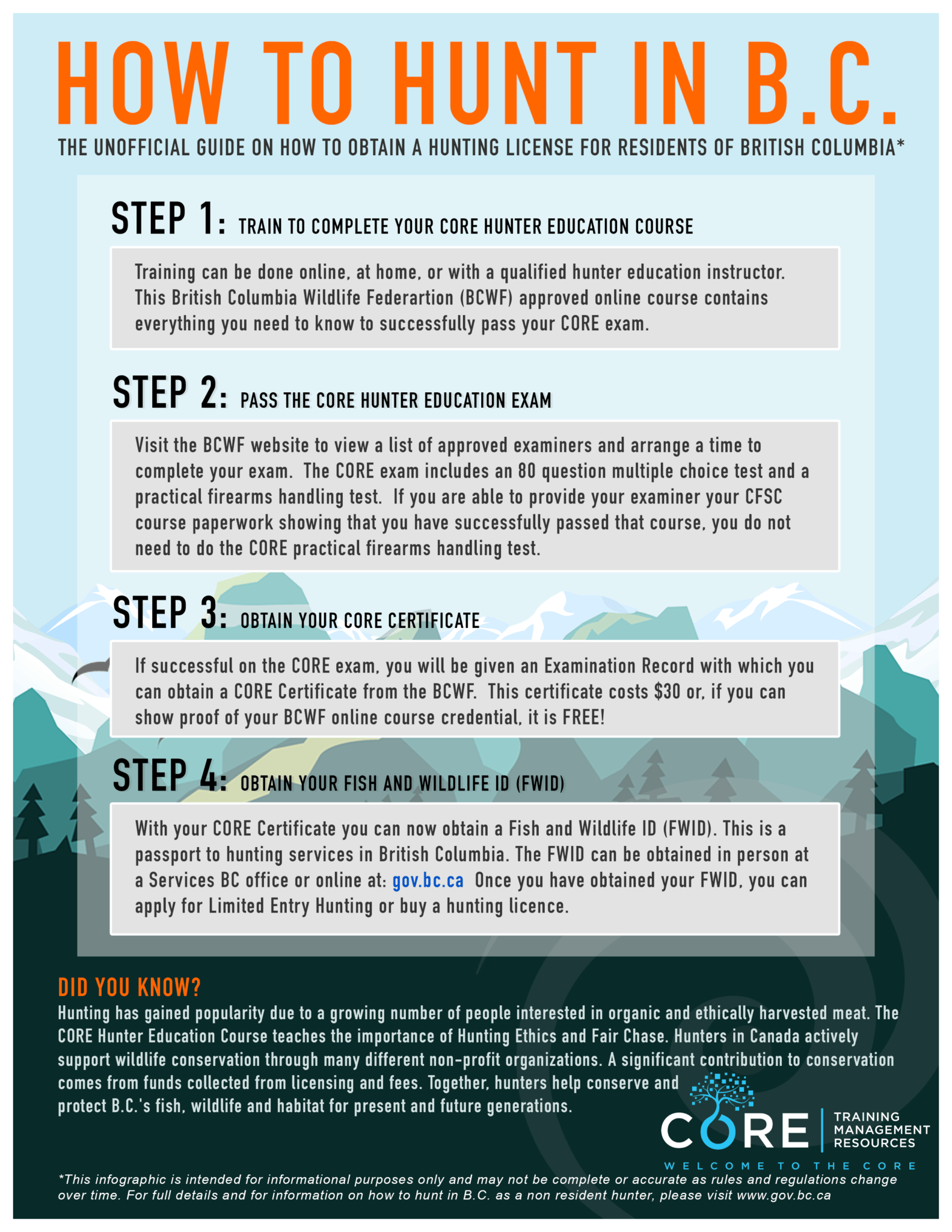
Your step-by-step path: CORE, FWID, and your hunting licence
Getting set up to hunt in British Columbia looks more complicated than it is. There are a few steps, they have to happen in a particular order, and most of the confusion comes from not knowing which step is which. This guide walks the whole path start to finish, the way I would explain it to someone standing in our Delta office asking where to begin.
Here is the short version, then the detail.
The path in four steps
- Complete your CORE (Conservation and Outdoor Recreation Education).
- Get your Fish and Wildlife ID (FWID).
- Buy your hunting licence, plus any species licences (tags) you need.
- If you are hunting with a firearm, get your PAL.
Do them in that order and you will be in the field legally. The infographic and video above cover the quick version. Here is the full walkthrough.
Step 1: Complete your CORE
CORE, the Conservation and Outdoor Recreation Education program, is the hunter education standard in BC. With one exception I will cover below, you need it before you can hold a hunting licence. It covers firearms safety, conservation, ethics, wildlife identification, the regulations, and outdoor survival basics.
You can take it in person over two days, or online at your own pace. You can register in person here. Silvercore is the BC Wildlife Federation's online CORE provider, so the online course meets the same standard, done from home. You can start the Online CORE Hunter Education Course here.
CORE includes a practical component. If you have passed the Canadian Firearms Safety Course, you are exempt from the CORE practical test, but you prove it with your CFSC course report, which you receive at the end of class once you pass. Your PAL on its own is not accepted as proof under BC Wildlife Federation rules. Since Possession Only Licences (POL) were rolled into full Possession and Acquisition Licences a number of years ago, holding a PAL does not show that you completed the CFSC.
If you plan to hunt with your own firearm, take the CFSC first and CORE second. There are two reasons. You learn to handle a firearm properly in the firearms course before the hunting course tests you on it, and the CFSC course report you walk out with exempts you from the CORE practical.
Step 2: Get your Fish and Wildlife ID (FWID)
Your FWID is your identity in BC's hunting system. It is the profile every licence and tag attaches to, and you set it up in the province's WILD system.
You have two ways to log in to WILD: a Basic BCeID or a BC Services Card Account. The BC Services Card Account is the one I would use: if you are a BC resident, it can automatically grant or renew your BC resident credential when you are eligible, which is one less thing to chase. With a Basic BCeID you upload your identity and residency documents yourself.
If you would rather do it in person, FrontCounter BC and Service BC offices can set you up, and some licence vendors can too, so call the vendor first. Bring photo ID. If you already have an FWID but have not logged in for a while, sort that out before the season, not the night before you want to hunt. Your BC resident credential expires every three years, and an expired one blocks licence and LEH purchases, so check the date on your profile. Our walkthrough on how to update your FWID covers the common snags. You can log in to WILD and start at gov.bc.ca/hunting.
The FWID on its own does not let you hunt. Once you pass CORE, you add the hunting credential to your profile yourself, by uploading your CORE certificate in WILD or taking it to a FrontCounter BC or Service BC office; online applications can take up to three business days to review, and in-person applications are active immediately if approved. Our guide on how to get your FWID in BC walks through every step.
Step 3: Buy your hunting licence and tags
With your CORE done and your FWID active, you can buy your hunting licence through WILD online, in person at a FrontCounter BC or Service BC office, or at a licence vendor. Many sporting goods and outdoor stores sell hunting licences on behalf of the province, but not every store that sells hunting gear is a vendor, so check the province's licence vendor list or call first. Licences are electronic. You can print one from your FWID profile, but you do not have to.
Most hunts also need a species licence, what hunters usually call a tag, for the specific animal you are after. Species licences are issued on tearproof paper and have to be physically carried while you hunt, so if you are heading out in the next few days, buy them in person rather than waiting on the mail.
A basic resident hunting licence is $32: a $25 licence fee plus a $7 Habitat Conservation Trust Foundation surcharge, plus GST. Youth and senior (65 or older) licences are $7. Species tags are extra and vary by species. For a BC resident, a black bear licence is $16 plus a $4 surcharge, mule deer or white-tailed deer $12 plus $3, moose or elk $20 plus $5, cougar $24 plus $6, and mountain goat $32 plus $8, all before GST. The full fee schedule is on the province's hunting licences page, and every species price is on its species licences page.
One option worth knowing about is the Initiation Hunting Licence. It is a one-time, $19 licence for a BC resident 18 or older who has never held a BC hunting licence, other than a youth licence. It waives the CORE requirement for one year so you can try hunting under the close personal supervision of a qualified licensed hunter, who signs a supervisor form before each day you hunt. The initiation hunter cannot buy species licences or apply for LEH; anything you take counts against your supervising hunter's tags and bag limit. You can only use it once.
Step 4: If you are hunting with a firearm, get your PAL
CORE and a hunting licence let you hunt. They do not, on their own, let you carry a firearm. To possess and use a firearm in BC you need a federal Possession and Acquisition Licence (PAL), which comes from the Canadian Firearms Safety Course.
There are two ways to be legal in the field with a gun. Get your own PAL and hunt under your own authority, or hunt with a firearm only while under the direct supervision of someone who holds a valid PAL. Most people serious about hunting get their PAL, and I would recommend it. It is the difference between hunting on your own terms and always needing someone beside you. The CFSC you take to get it is also what exempts you from the CORE practical, as noted above.
If you are going this route, take the Canadian Firearms Safety Course (non-restricted and restricted). And if you want the complete licensing walkthrough, start with our guide on how to get your PAL in Canada.
What you can hunt, seasons, and LEH
Once you are licensed, what you can actually hunt depends on the species, the region, and the season. Some species are open under a General Open Season. Others are only available through Limited Entry Hunting (LEH), BC's draw system, and a few are draw-only. Always check the current Hunting and Trapping Regulations Synopsis for your specific hunt before you go.
Ducks and geese need one more document, and it does not come from WILD. The federal Migratory Game Bird Hunting Permit is issued by Environment and Climate Change Canada. It is $17 plus applicable taxes, a figure that includes the $8.50 Canadian Wildlife Habitat Conservation Stamp, it runs from 1 August to 30 June, and you buy it as an e-permit online, at a select Canada Post outlet, or from an independent vendor.
For more on each: what animals you can hunt in BC, our guide to Limited Entry Hunting, and the latest on BC hunting regulations.
Do not overlook insurance and the Silvercore Club
One thing new hunters skip until it bites them is liability coverage. The Silvercore Club includes $5 million in third-party liability insurance through Lloyd's of London that covers your outdoor activities, hunting included, not just range time. Membership also gets you partner discounts, free online courses, the members-only podcast, and it counts toward the club requirement for an Authorization to Transport. It is $59 a year.
Continue on the Silvercore Path
- Take the course: CORE Hunter Education Course, in person or online.
- Set up the account: How to get your FWID in BC.
- Get the firearms licence: How to Get Your PAL in Canada.
- Carry cover in the field: the Silvercore Club, $59 a year with $5 million in liability coverage.
Frequently asked questions
Do you need a licence to hunt in BC?
Yes. To hunt legally in BC you need to complete CORE, hold an active Fish and Wildlife ID, and buy a hunting licence, plus a species licence (tag) for most animals. If you are using a firearm, you also need your PAL, or the direct supervision of someone who has one.
Can I buy a BC hunting licence online?
Yes. You buy hunting licences through the province's WILD system online, or in person at FrontCounter BC, Service BC or a licence vendor. One thing to watch: species licences (tags) bought online are mailed to you, so if you are hunting within a few days, buy those in person.
How much does a BC hunting licence cost?
A basic resident hunting licence is $32: a $25 licence fee plus a $7 Habitat Conservation Trust Foundation surcharge, plus 5% GST. Youth and senior (65 or older) licences are $7, and the one-time Initiation Licence is $19. On top of the licence, most hunts need a species licence (tag) for the specific animal, and tag prices vary. The full fee schedule is on the province's hunting licences page.
What is the fine for hunting without a licence in BC?
Hunting without a hunting licence carries a violation ticket of $500 plus a $75 victim surcharge, $575 in total. Wildlife Act ticket fines run from $345 to $1,495 depending on the offence, with the highest amounts reserved for serious cases like taking big game out of season. On top of the fine, a conviction can mean licence suspension or cancellation and seizure of your gear, so it is not worth the gamble.
Do you need CORE to hunt in BC?
Yes, with one exception. CORE is required before you can get a hunting licence. The only way around it is the one-time Initiation Hunting Licence, which waives CORE so you can try hunting under supervision before committing to the full path. Hunter education you completed in another province, territory or country also counts: WILD accepts that jurisdiction's proof of completion as your hunting credential, with a notarized translation if it is not in English or French.
Do you need a PAL to hunt in BC?
To hunt with a firearm under your own authority, yes. Without a PAL you can still hunt with a firearm, but only under the direct supervision of someone who holds a valid PAL. You can also hunt with a bow without a PAL, subject to the same CORE, FWID, and licensing requirements.
Where to start
If you are starting from zero, the order is simple: book your CORE first, because everything else hangs off it. You can register for the in-person course or start the online CORE course. Get that done and the rest is paperwork.
The situation depicted in the infographic applies to residents of BC only. Government rules and regulations are always subject to change, if you have any questions or concerns whether the information stated above is still 100% accurate or complete, please contact our office today.


