BC hunting regulations: what's current and what's changing
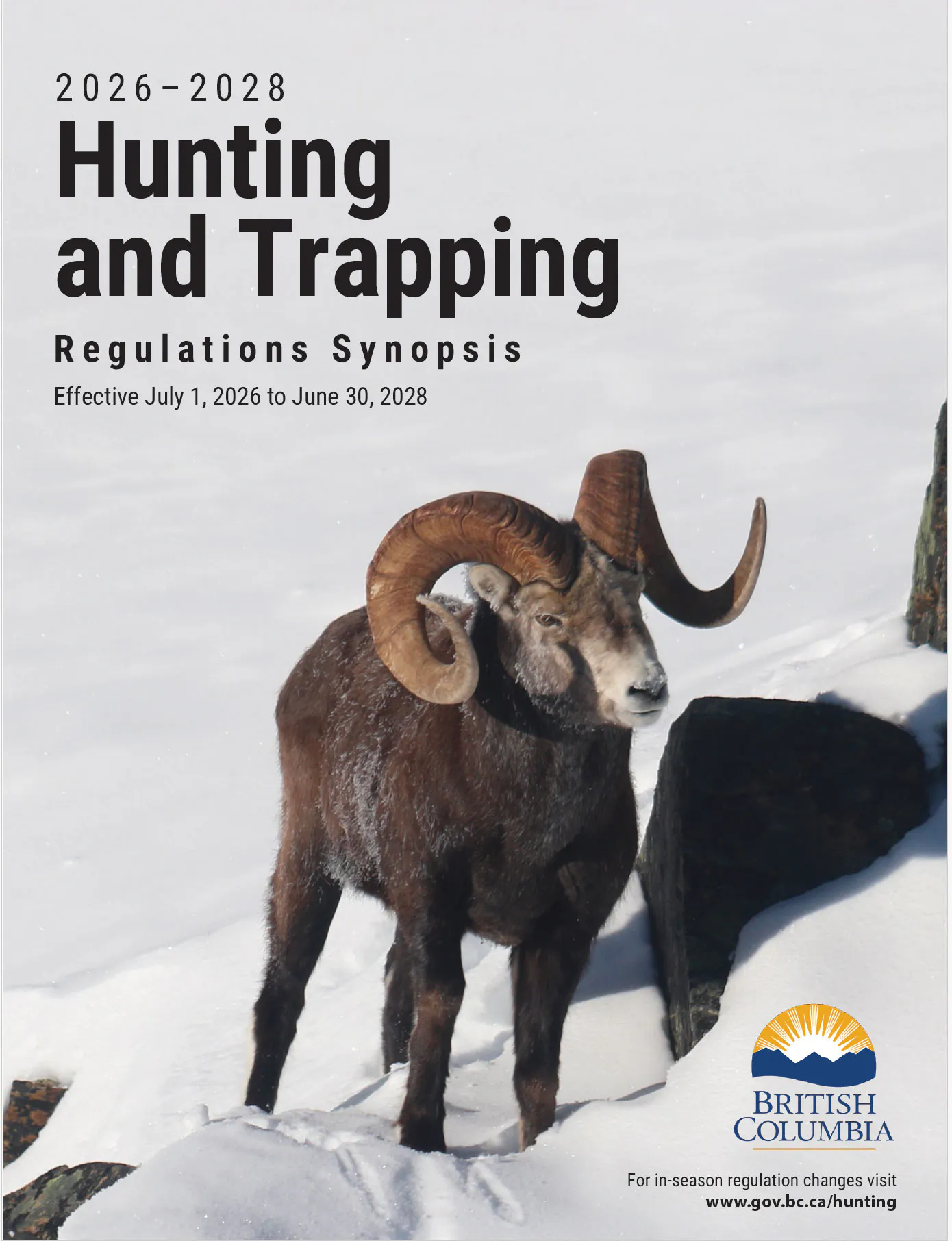
BC reviews its hunting and trapping regulations on a two-year cycle. The current rules, the 2026-2028 Hunting and Trapping Regulations Synopsis, took effect July 1, 2026 and run through June 30, 2028. Here is what every BC hunter needs to know right now.
Before the season: regulations change every two years, and your PAL expires every five. Silvercore Club membership tracks your PAL expiry, carries $5 million in hunting liability insurance through Lloyd's of London valid across North America, and satisfies the Fraser Valley insurance requirement outright. $59 a year. Join the Silvercore Club.
The current synopsis: 2026-2028
The 2026-2028 Hunting and Trapping Regulations Synopsis is the governing document, and you can download the full PDF from the Province of BC, along with a summary of what changed this cycle and why. The province is divided into nine administrative regions and 225 management units, and each unit has its own season dates, bag limits, and access restrictions. Always check the corrections and updates page before you head out, because changes are posted there through the season and the printed synopsis will not show the latest amendments.
Chronic Wasting Disease (CWD): the biggest recent change
CWD has been confirmed in BC in the Kootenay region, with nine confirmed cases as of January 2026, and it remains the single most significant regulatory development affecting hunters. The 2026-2028 synopsis carries these requirements forward:
- Mandatory CWD testing is required for all deer, elk, and moose harvested in management units 4-1 to 4-8 and 4-20 to 4-25, within one week of harvest.
- Carcass transport is restricted: you cannot move the brain tissue or spinal column (except the tail) of a cervid outside the CWD Management Zone. Leave those parts at the kill site or dispose of them properly before you leave the area.
- If your only route to a CWD freezer means leaving the zone, contact the Wildlife Health Program first to discuss transport options.
- The province is encouraging hunters to keep hunting in affected areas, because harvest is the most effective tool for slowing CWD by removing infected animals.
For the current management zone, dropoff and freezer locations, and your test results, see gov.bc.ca/chronicwastingdisease.
Compulsory inspection changes (September 2025)
Effective September 29, 2025, several species no longer require compulsory inspection. The main exception is moose in Management Units 6-1 to 6-11, 6-15, 6-17 to 6-30, and the portion of 7-52 accessed through Region 6, which still require inspection within 30 days of the kill. If you hunt a species that used to require inspection, confirm the current rule in the 2026-2028 synopsis before your hunt.
Nuchatlaht First Nation title declaration
The BC Supreme Court has declared that the Nuchatlaht First Nation holds Aboriginal title to a portion of Nootka Island. The declared area overlaps a small part of Management Unit 1-12. If you plan to hunt, trap, or fish there, you must get permission from the Nuchatlaht Chief and Council before entering their title lands.
Now in effect: the 2026-2028 regulations
The province ran public engagement on roughly 60 proposed changes for the 2026-2028 cycle between January 12 and February 13, 2026. Proposals covered season structure, LEH and General Open Season opportunities, harvest methods, access management, and a move toward digital-only regulation delivery. The BC Wildlife Federation published its position on the proposals. The finalized synopsis took effect July 1, 2026, and the province has published a summary of the changes and the reasons behind them. If you applied for LEH or you plan multi-year hunts, read the new synopsis rather than working from memory of the old one, because season dates, authorization numbers, and access can all shift between cycles.
Limited Entry Hunting (LEH)
Some species and zones are draw-only through BC's Limited Entry Hunting system, which runs separately from General Open Season. The LEH synopsis is published on its own schedule and the application deadlines move each year. For how LEH works, the current deadlines, and how to apply, see our guide to Limited Entry Hunting in British Columbia.
Licensing and credentials
To hunt in BC you need a valid FWID (Fish and Wildlife ID), a basic resident hunting licence ($32, a $25 fee plus a $7 Habitat Conservation Trust Foundation surcharge, plus GST), and the appropriate species licences for what you are after. All non-resident hunters pursuing big game must be accompanied by a licensed guide outfitter, assistant guide, or a resident holding a valid Permit to Accompany.
If you do not have your FWID yet, you complete the CORE Hunter Education course first. Silvercore offers CORE in person and online. For the full path from CORE to your licence, see how to get your BC hunting licence.
One credential this section does not cover is the firearm licence. CORE and a hunting licence let you hunt. Neither one lets you carry a firearm. That takes a federal PAL, which comes out of the Canadian Firearms Safety Course. You can hunt with a firearm under the direct supervision of someone who holds a valid PAL, but most people who hunt more than occasionally want their own. If that is you, we run the combined CFSC and CRFSC course.
If you hold a moose species licence, you must submit a Mandatory Hunter Report by January 15, whether or not you harvested. Missing it can affect your future licence eligibility.
Regional regulations
On top of the province-wide rules, every region layers its own seasons, bag limits, closures, and access restrictions, and the synopsis is organized by region. BC's nine hunting regions are:
- Region 1: Vancouver Island
- Region 2: Lower Mainland
- Region 3: Thompson
- Region 4: Kootenay
- Region 5: Cariboo
- Region 6: Skeena
- Region 7A: Omineca
- Region 7B: Peace
- Region 8: Okanagan
Regional rules change every cycle, so rather than list specifics that go stale, check the regional section of the current synopsis for the unit you are hunting. Region 4 (Kootenay) in particular carries the CWD testing and carcass-transport requirements covered above.
A note on insurance
One thing worth sorting before the season is liability coverage. If your hunt is in the Fraser Valley Special Licence Hunting Area (Management Units 2-4 and 2-8), you are legally required to carry at least $1 million in third-party liability insurance for hunting. The Silvercore Club includes $5 million in third-party liability coverage through Lloyd's of London, valid across North America, which exceeds that requirement and covers your hunting outside the Fraser Valley too. It is $59 a year.
Where to find the official information
- Full 2026-2028 synopsis (PDF) and regional sections: gov.bc.ca regulations synopsis
- Corrections and updates: in-season changes page
- CWD information: gov.bc.ca/chronicwastingdisease
- Licensing, LEH applications, WILD: gov.bc.ca/hunting
This article is an informational guide to help you understand the current regulatory landscape. It is not legal advice. Always consult the official synopsis and contact your regional Fish and Wildlife office about specific regulations in your area.